Agung Keramik Redesign
- UX research
- strategy
- website redesign (information architecture, UI mockups)
- SEO
- content strategy
- social
- KOL marketing strategy
- 3D product viewer prototype
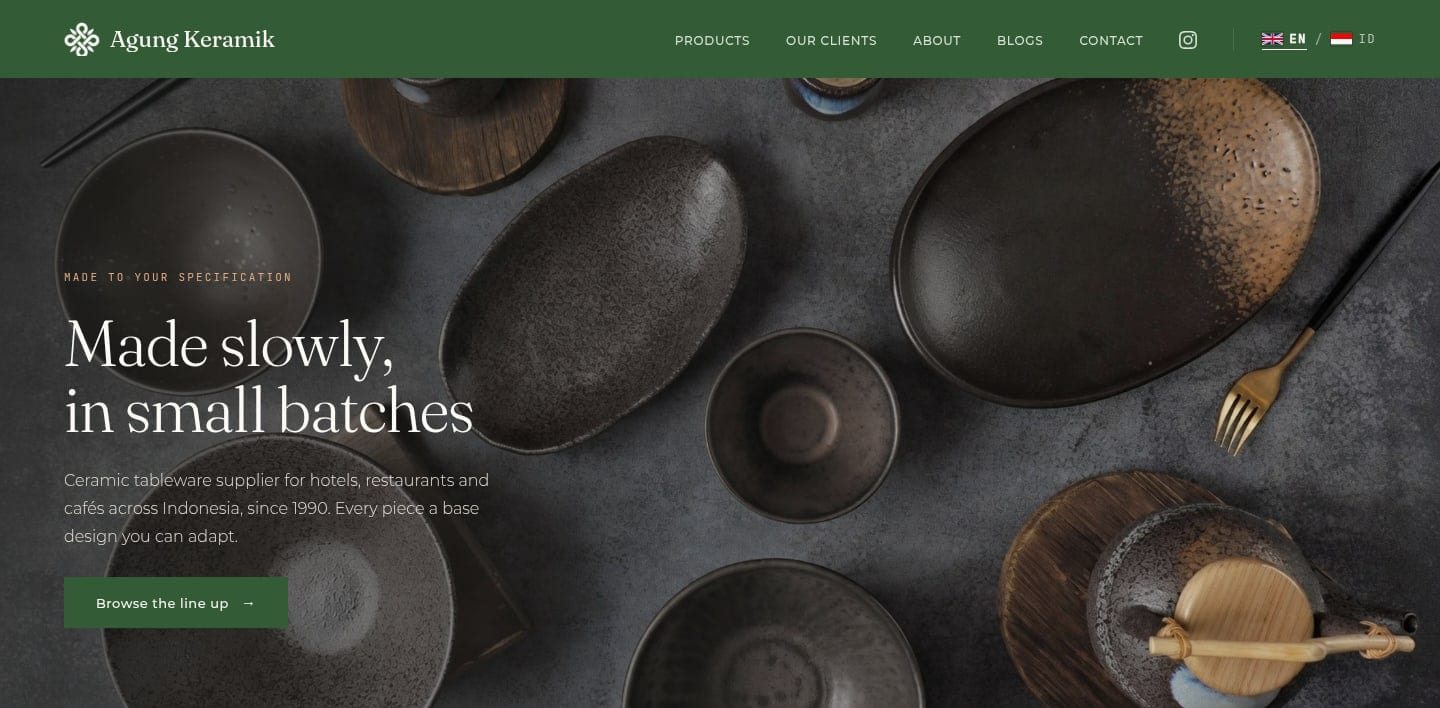
A management consultancy project with NTU's PEAK ASEAN, redesigning the digital experience of Agung Keramik.
Brief
Agung Keramik makes custom earthenware in Jakarta for hotels, restaurants and cafés. It wins on quality, flexible order sizes and customisation, and almost all of its clients arrive by word of mouth, with many of those relationships built by the previous generation of owners. The client is facing problems in attracting new buyers and expanding to overseas markets.
As such, after refinements with the owners, we arrived at a problem statement:
How might we design a digital B2B experience that helps local and global buyers discover, specify, sample and reorder AK products, so that AK competes on experience and trust rather than price?
Key decisions
A digital namecard where every page ends in a conversation
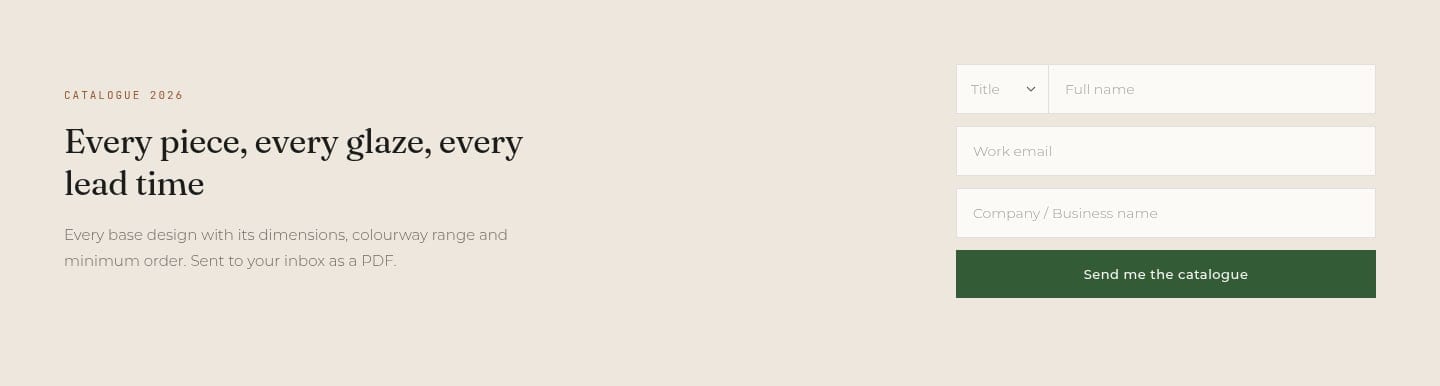
Our survey of existing clients showed they don’t buy online. They visit the showroom or, more often, get in touch directly. So the site is presented as a preview of what AK offers, backed by proof of who already trusts it. Its job is to earn a place on a buyer’s shortlist and hand them to a sample, a quote or a showroom visit. That means every page needs to be findable, credible and contactable.
Handing over happens in the channel Indonesian B2B buyers actually use. The two highest-scoring competitors put WhatsApp everywhere; AK had it nowhere. Each contact point matches a different level of intent.
-
WhatsApp floating button on every page
-
Request a quote on product pages form tagged with the page it came from.
Social proof from clients does two jobs. For HoReCa supplier seekers, it shows that hotels and restaurants already source from AK, which builds the trust needed before a volume order. For everyone else, it shows the products in real service, a more convincing preview than any catalogue shot.
[Image of testimonal part]
Curate the entry, keep the breadth
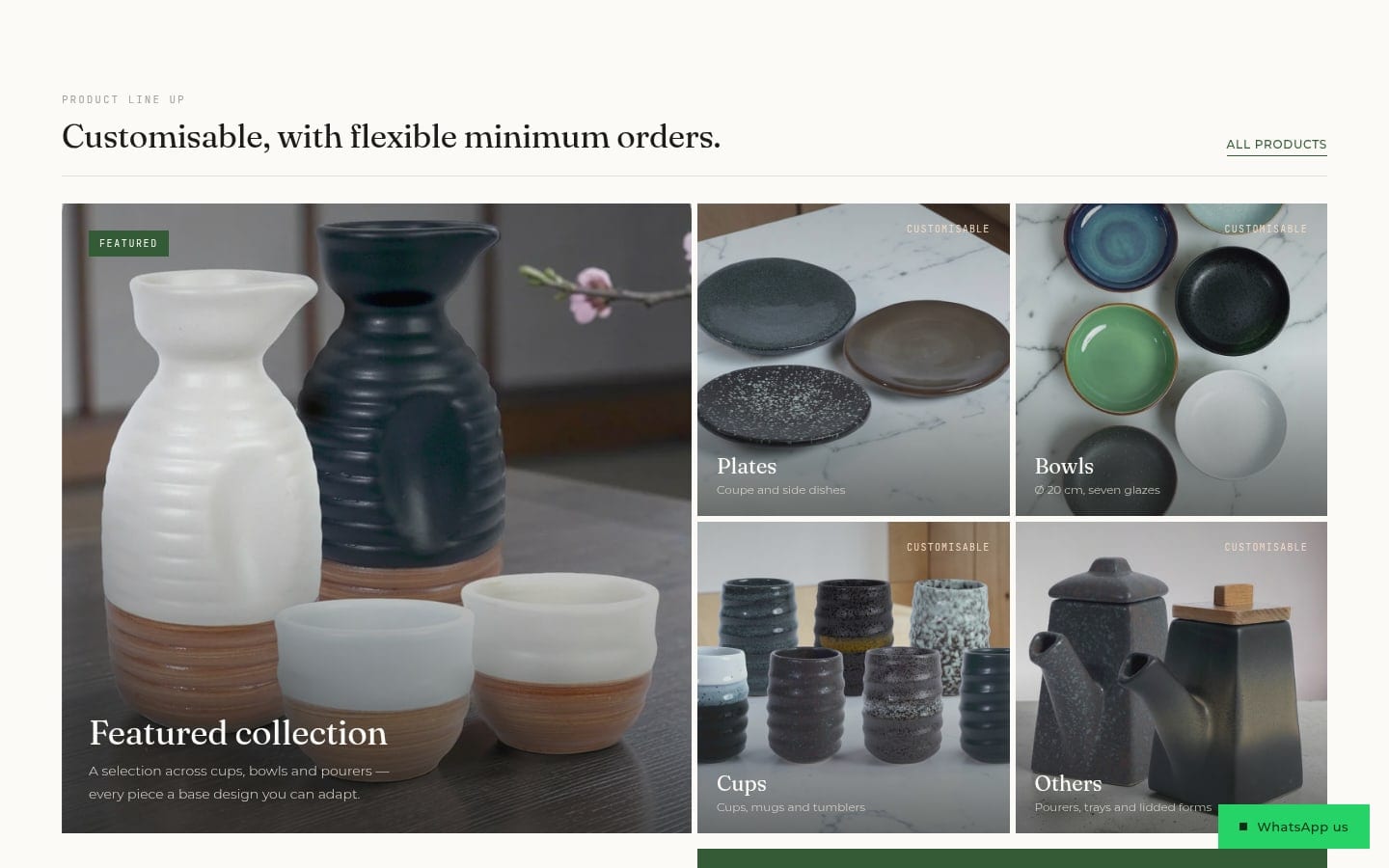
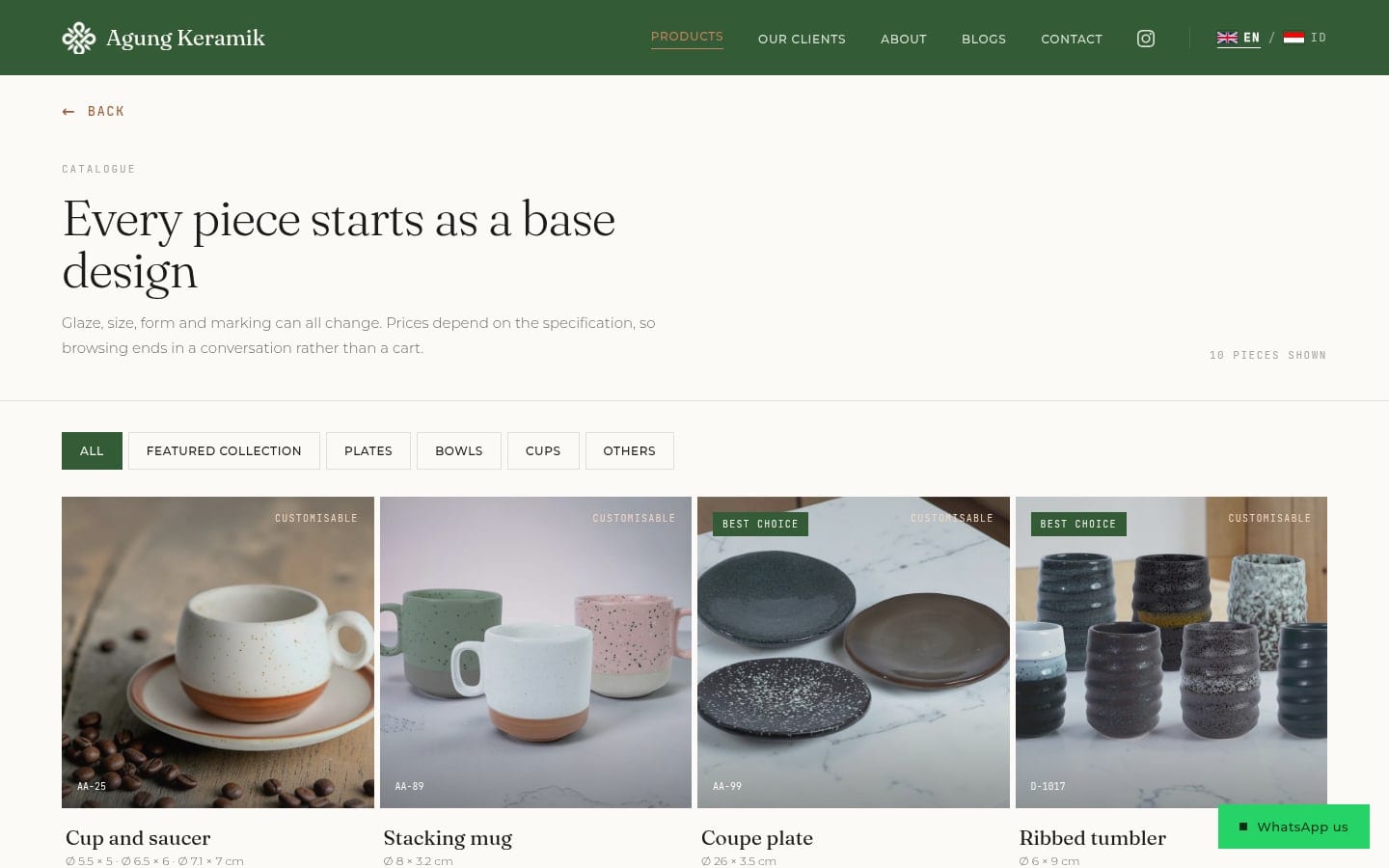
AK has over a thousand SKUs because of the brand’s emphasis on customisablity. Showing them all may provide too many options and buyers stall or leave (Iyengar & Lepper 2000; Chernev et al. 2015).
So the catalogue is entered through curated collections that aims to show the breath of designs achieve with them.
Content translated to search
AK ranked only when directly searching for the brand, and the words that describe its products best get very few searches. Specialist terms like “earthenware” barely register. To broaden the ranges of searches leading to the site, we use blog content as a broader SEO net, covering topics HoReCa businesses already search for: tableware ideas for a new restaurant, choosing plates for hotel dining, or what to look for in a supplier. Each article brings searchers onto the site and links them through to relevant products, turning a general search into a first look at AK and securing a possible contact.
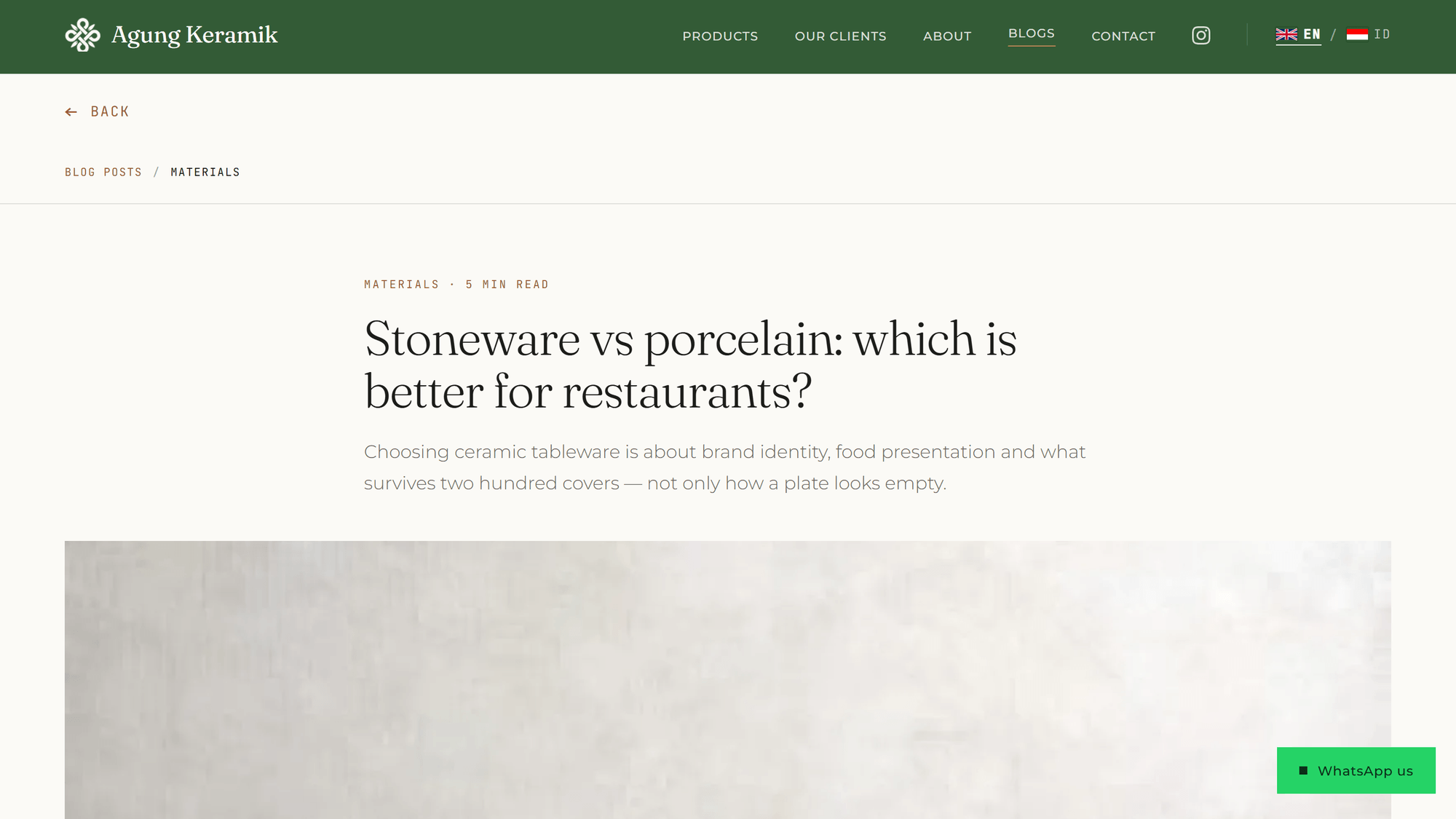
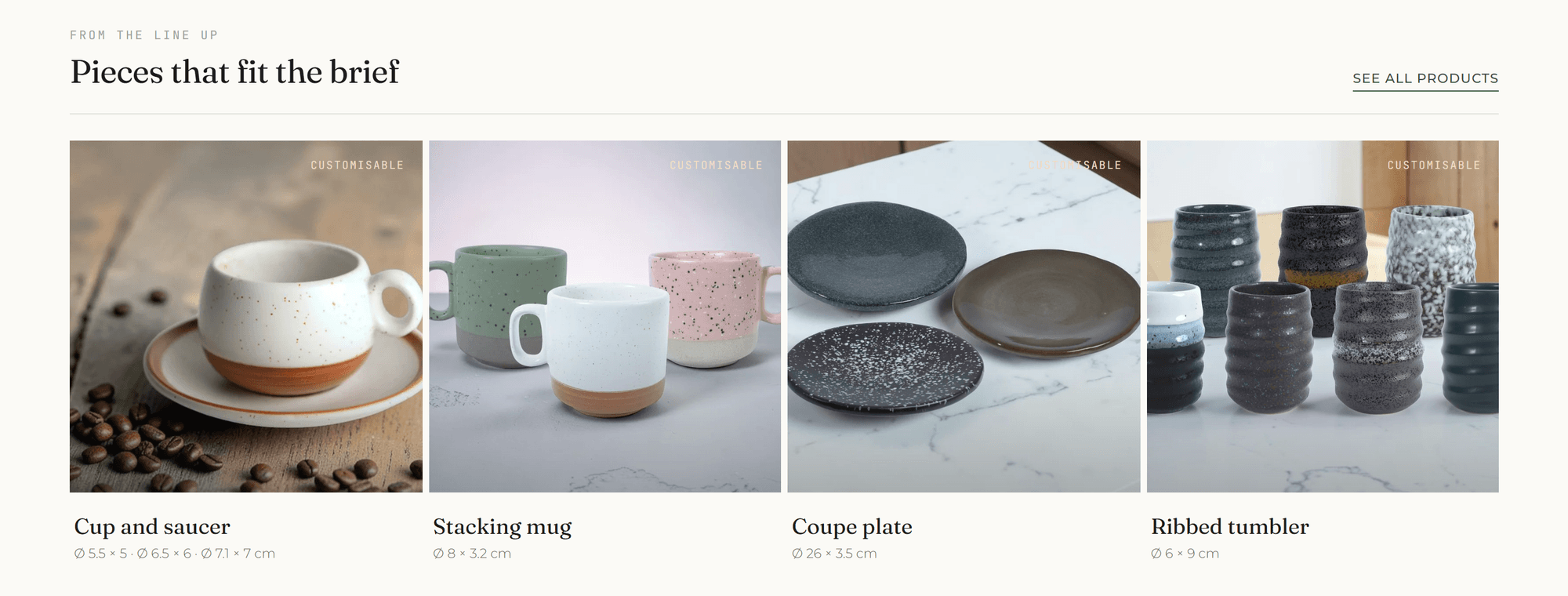
A working build of the redesign is online at agung-keramik.pages.dev.
UX Research
USER SURVEY (n = 13)
To understand how existing customers find, evaluate and buy from AK, we surveyed current buyers, including restaurants, hotel F&B teams and cafés. The survey asked how they first found AK, whether they used the website, how they prefer to browse, and what influences their purchase decisions. Ten businesses had responded by the handover on 7 August 2026, and thirteen have responded to date. The figures below cover all thirteen.
Repeat purchasing. 9 of 13 respondents were returning customers, and all of them had bought from AK more than three times. Respondents rated their likelihood of recommending AK at an average of 4.7 out of 5.
Reasons to buy. 12 of 13 cited product quality and durability, 11 cited flexible minimum orders and 7 cited customisation. Only 2 cited the website.
Discovery. 10 of 13 first heard of AK through word of mouth, 8 of them from an existing customer. One found AK through Google.
Website use. 10 out of 13 had not visited the website before contacting AK. 9 out of 13 said they prefer to browse products at the showroom, which the ten respondents who had visited it rated 4.7 out of 5.
Requested features. Respondents asked for an online catalogue preview (7), product filters (6), a 3D product viewer (5) and a quotation request form (4).
These findings shaped the redesign in two ways. Since buyers were not purchasing through the site, we redesigned it to bring buyers into contact with AK and to the showroom, rather than to complete sales online. We also built the features respondents requested into the redesign.
Traffic analysis (raw logs)
Of 1,210 homepage visits, about 80% left without viewing a second page
Fewer than 7% reached the Product Line Up or Contact page.
Reconstructed visitor journeys from raw HTTPS server logs, anonymised and grouped into sessions by IP and timestamp.
Website UX analysis
Some product descriptions were misleading, still containing unedited Wordpress template copy about lighting and signage.
The site claimed 500+ variants but displayed very few.
There were no individual product pages.
There was no WhatsApp or phone number on the homepage.
SEO keyword search
AK does not appear for general terms such as “keramik”, “stoneware indonesia” or “supplier piring café”.
AK ranks well for specific hotel and HoReCa terms.
Competitor analysis and criteria creation
We compared six Indonesian producers across 11 weighted criteria.
AK scored highest on proposition clarity (5/5) and lowest on digital effectiveness (2.40/5).
Its closest competitor, Nuanza, makes the same custom HoReCa offer, supported by a product catalogue, a client list and an SEO blog.
Social media audit
Instagram posts from the same week ranged from 2 to 304 likes. The higher numbers came from paid Meta ads, which produced reach but no sales.
TikTok clips had 64–189 views.
This research was carried out over two weeks, which limited its scope in three ways.
Buyer journey coverage. Our methods focused on how buyers discover AK. We did not study how buyers specify, sample or reorder products, so our recommendations for these stages are based on the owners’ accounts and our analysis rather than direct observation.
Survey sample. All 13 survey respondents are existing AK customers. We did not speak with buyers who chose competitors or never found AK, so the findings may not reflect why prospective buyers do not choose AK.
Export markets. Our research focused on Indonesian buyers. Needs specific to international buyers, such as those in Saudi Arabia, were not studied directly.
What was delivered
A diagnostic and redesign package handed to AK on 7 August 2026, it consist of:
hi-fidelity mockups of the homepage, catalogue and product page
a UX design document with the competitor scoring, branding, design guidelines, information architecture and user flows
the SEO keyword set split by intent and mapped to pages, with three blog outlines
briefs for the creator pilots with cost ranges and measures
survey data and analysis
a measurement plan and roadmap
the 3D viewer prototype for possible addition to site
Contributions
I owned the selection side: the audit, the information architecture, and the redesign.
Audit: walked the live site against usability guidelines and analysed its traffic log. This produced the two numbers the whole case rests on (80% homepage exit, under 7% reaching products or contact) and documented the template copy, the missing product URLs and the absent instant contact.
Information architecture: restructured a single-page brochure into a homepage, a catalogue entered through curated collections, and individual indexable product pages. Defined the filters, gave every page one target term and a descriptive URL, and mapped each of the three buyer journeys to end at a quote request or a WhatsApp message.
Redesign: the hi-fidelity homepage, catalogue and product pages, including the credibility band, the client wall, specs on every card, the WhatsApp button, the quote form and the sticky action bar on mobile.
Team: Ng Wei Yan (search), Talitha Ananda and Rhyan Ramadhan (marketing and creator pilots), Elson Tan (build and refinement).
What I'd do differently
Everything above is argued from evidence about discovery and inferred for the rest. The survey only reached existing customers, so the people who never found AK — the actual problem — were never asked. The three journeys were designed from search intent and survey data, not tested with anyone.
So: install the analytics and capture a baseline, then usability-test the three journeys against real behaviour. Survey non-customers. Pull real search volumes before committing to keywords. Run one creator pilot against the enquiry measure before spending further.
Credits and rights
Team AK: Ng Wei Yan, Ivan Chen, Elson Tan, Talitha Ananda, Rhyan Ramadhan. Client: Agung Keramik.
Research cited: Iyengar & Lepper (2000); Chernev, Böckenholt & Goodman (2015); Häubl & Trifts (2000); Townsend & Kahn (2014); Shi et al. (2021); Jongmans et al. (2022); CMO Council and Gartner B2B buying research.
Product photography belongs to AK. Client logos, creator photos and venue imagery belong to their owners and are not published without permission.