PSA Commander Dashboard
- Applied AI engineering
- retrieval systems
- agentic workflows
- operations dashboard
A dashboard that helps marine port case officers diagnose and escalate faults. It pulls up how similar cases were handled before and what procedure allows, then leaves the decision to the officer.
Brief
Faults reach a port control room by phone, message and email. For each one a case officer has to work out what went wrong, then fix it or escalate it to the right department. That needs two things at once: precedent, how similar cases were handled before, scattered across past incident records; and policy, what the standard operating procedures allow. Finding both takes time, the two don’t always agree, and incidents keep arriving while the case officers compare.
Can AI get a case officer to the relevant precedent and the relevant procedure fast enough to change how quickly they respond?
Developed as part of the PSA Code sprint hackathon where we clutch a commendation prize (top 20) out of 300 teams.
How much to automate
The question wasn’t how clever the model could be, but how much to automate. Sheridan and Verplank’s levels of automation treats automation as a single scale, where more automation means less control. Shneiderman’s human-centred AI framework treats control and automation as separate axes, so a system can be high on both. The feature was designed to do exactly that: automate the heavy lifting while keeping the users in control of the final decision.
Key Features
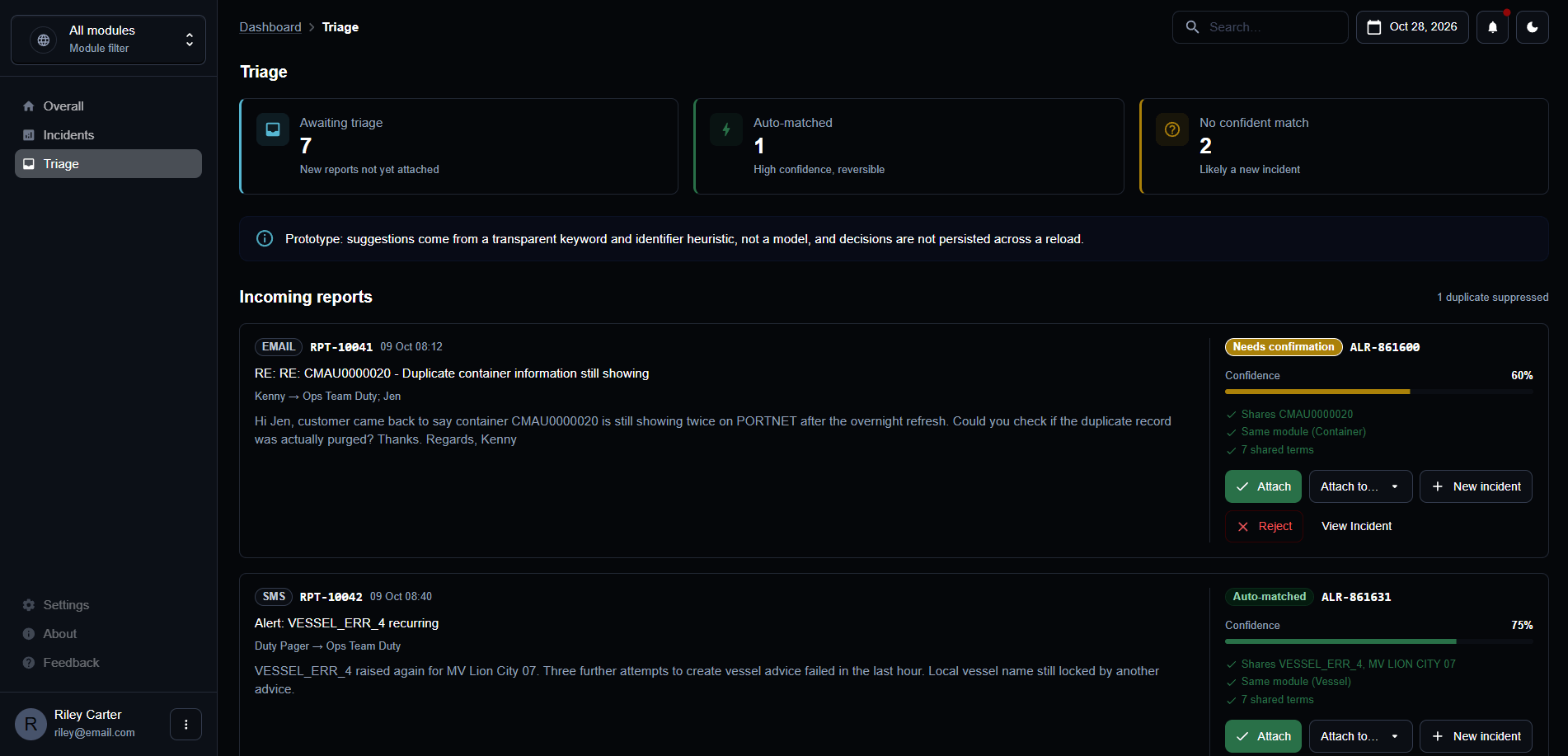
Classification and triage
Every incoming message is scored against the open incidents and lands in one queue. High-confidence matches come pre-filled with a suggested incident so the officer only needs to confirms or simply acknowledge in notification. Either way the officer has to decide, the system never attaches anything on its own.
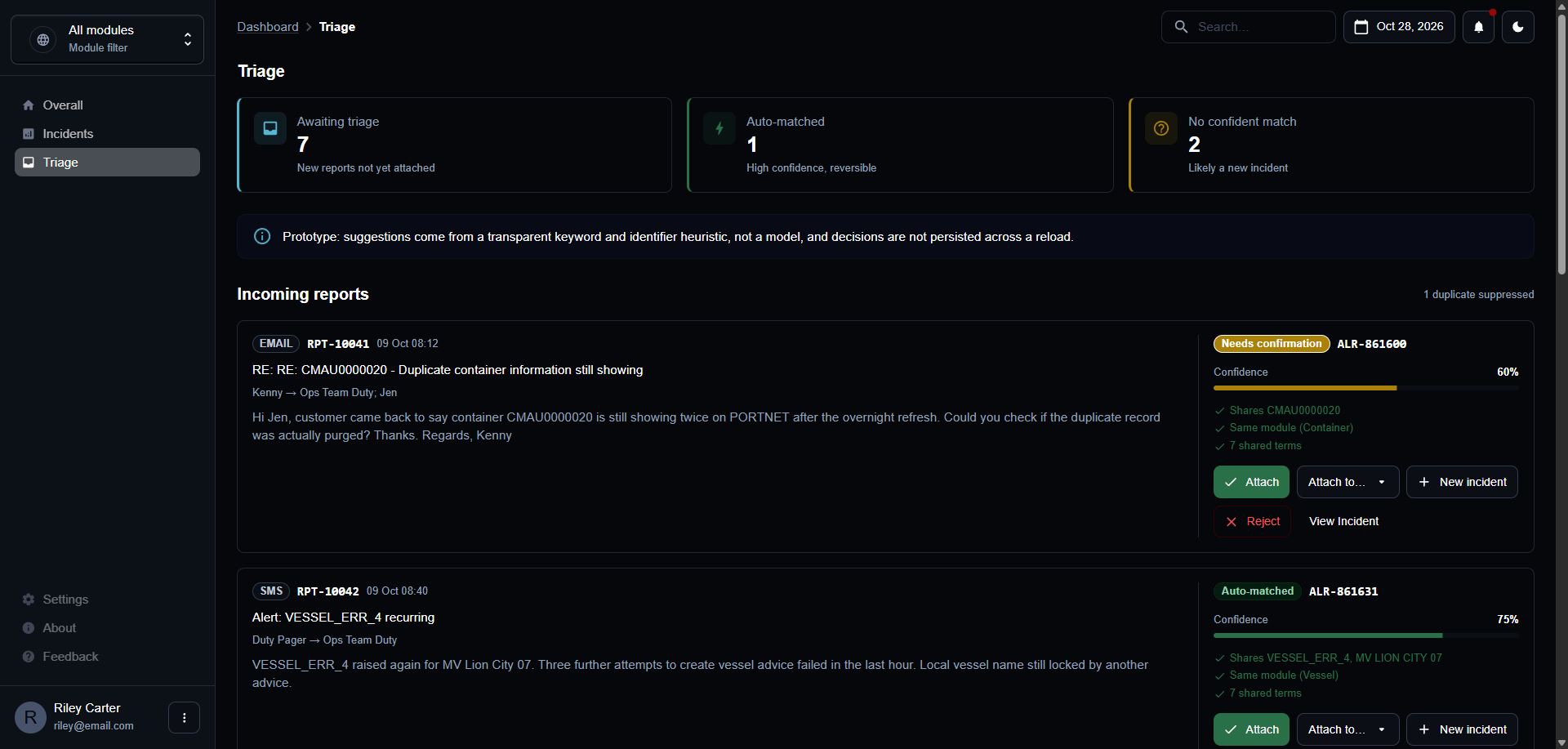
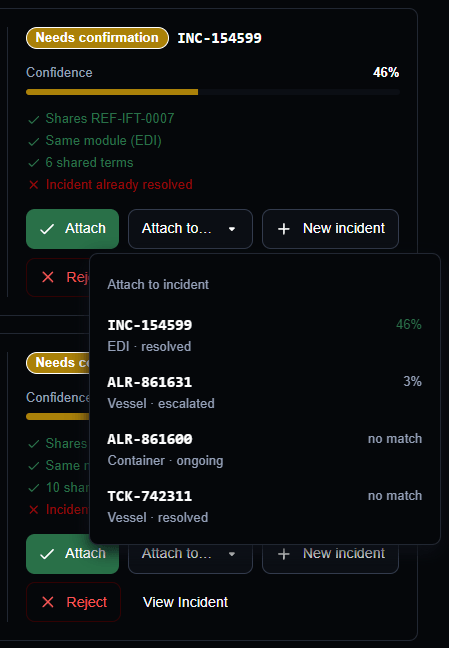
Each suggestion shows the reasoning for the selection. Repeat deliveries of the same message are flagged as duplicates and don’t count as new evidence.
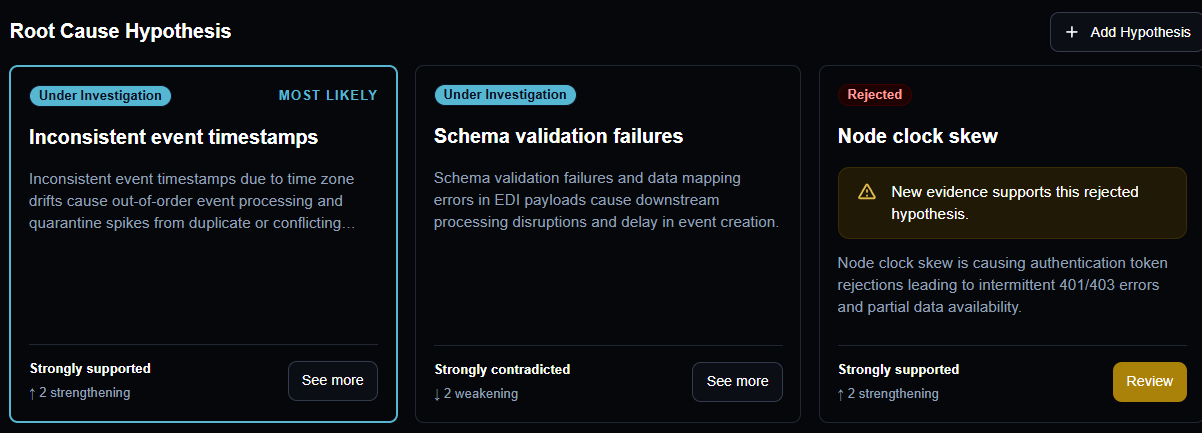
Hypothesis
Each incident carries a few candidate causes, ranked, with the leading one marked. New evidence tilts a hypothesis one way or the other, and the card reads Supported, Mixed evidence or Strongly contradicted.
Escalation
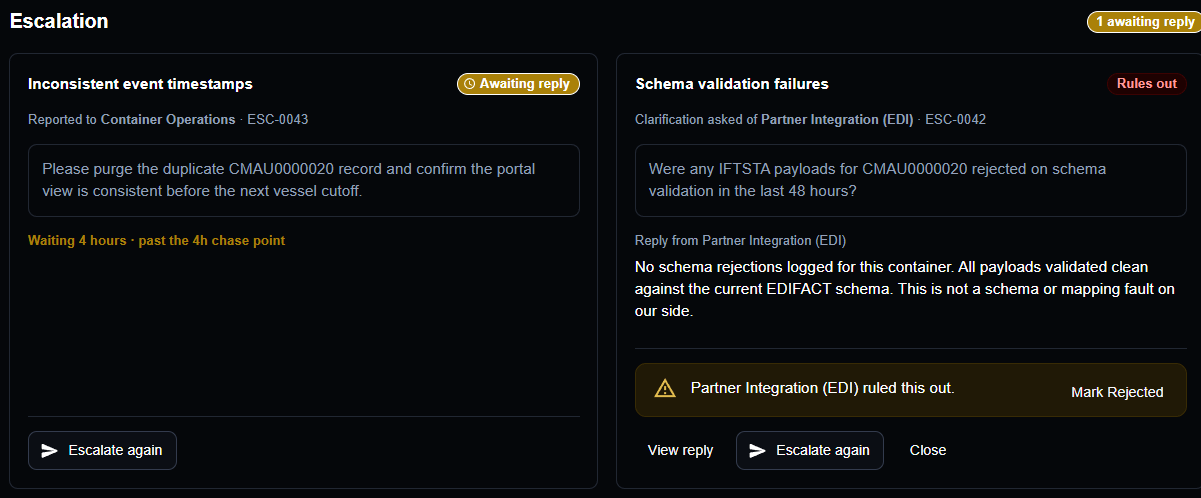
Any candidate cause can be sent to the department that owns the area. The reply comes back as part of the incident’s message log and counts as evidence.
Next steps
Once enough evidence from the ground and other departments has ruled out most hypotheses, the next steps are recommendations, giving officers a clear possible path to resolve the issue.

How it’s built
Tech Stack
Frontend: A Next.js dashboard with an incident grid, a page per incident, and charts. It started from MUI’s dashboard template, because the project’s value is in the reasoning and the content, not the chrome around it.
Backend: FastAPI with SQLAlchemy.
AI layer: The LangGraph workflow, the two search tools, and the MCP service that retrieves procedures.
Hosting: Azure.
Two kinds of search, because the documents need both
Procedure documents contain two kinds of text. Exact phrases, procedure codes and error strings need keyword search. Broad questions, like “what do we do when a crane stops responding?”, need meaning-based search over embeddings, which finds the right section even when it uses different words.
So we incorporated hybrid search using BM25 for keyword search and vector embedding for similarity search.
Retrieved results carry their authority
A system that just shows precedent next to policy pushes the hard part back to the officer. So results don’t come back as a flat list. Past incidents carry confidence scores, and procedure sections carry authority levels. This lets the system weigh precedent against policy when they disagree, and lets the officer see why one was ranked above the other.
The open problem is explaining the scores themselves. The officer can see that one result outranks another, but not yet in plain terms why it earned that score. Making the scoring explainable needs more scrutiny and development, and it’s something our team did not resolve yet in our prototype.
Search runs as its own service
Retrieval sits behind a MCP server, a standard protocol for exposing tools to a model, rather than being an in-process function call. That adds one more hop under time pressure. In exchange, the search layer is more decoupled and easier to develop isolation.
Contribution
A working prototype of the full loop message in, causes proposed with their supporting procedures, escalation, resolution on synthetic data.
It took a commendation prize, placing in the top 20 of roughly 300 teams.
Mine: the UX and UI design, the dashboard front end, the CRUD layer, and the AI client setup.
The team
Seen (Siravit Keeratipranon): built the MCP server with hybrid search over procedures and past cases
Wenhong: set up the Azure databases and hosting
Ashitisha: built the pitch and presentation.
What I’d do differently
The data stayed synthetic, so the hardest part was never tested: real procedures, real incidents, and real contradictions between them. That’s also the project’s central claim, which makes it the first thing to prove.
So: load a real document set, even a public one, and measure whether hybrid search actually beats either method alone on procedure lookups. Then write a handful of deliberately contradictory cases and watch how the system weighs precedent against policy.
Credits
Team: Ivan Chen, Siravit Keeratipranon, Wenhong, Ashitisha. Built from the sprinted-away repository. Mock procedures and test data only — no PSA operational data was used.